
Loading...
Using Artificial Intelligence (AI) on ASTM standards and related intellectual property is prohibited. Violations will result in suspension of access.

By Jack Maxwell
Mar 02, 2026
The average age across the approximately 340 million individuals who call the United States home has been rising in recent decades. This phenomenon is not breaking news, but the numbers are instructive nonetheless.
As of July 1, 2024, the U.S. Census Bureau estimated that approximately 18 percent of the country’s total population was 65 years of age or older. According to USA Facts, the share of the population represented by this age group stood at 13.1 percent in 2010 and increased nearly 43 percent between 2010 and 2022, making it the fastest-growing slice of the demographic pie in that time period.
These numbers are buttressed by the Population Pyramids website, which creates infographics based on United Nations’ world population data. Its analysis indicates that the median age of the U.S. population has increased from 28.1 to about 39 since 1970.
The Congressional Budget Office (CBO) offers yet another metric that captures this shift. The CBO pegs the ratio of people in the 25 to 64 age group (the prime working-age demographic paying into Social Security) to those 65 or above at 2.9 to 1. By 2054, it is projected to fall to 2.2 to 1.
All this is to say that the elderly currently represent a significant proportion of the U.S. population, a proportion that is expected to increase in coming decades. Advances in health care are obviously a major factor in this increased longevity. Less dramatic but also a factor is the realization that certain household products can pose unexpected dangers to those whose physical and mental capacities may be diminished.
ASTM International’s committees on medical and surgical materials and devices (F04) and consumer products (F15) are helping to ensure that devices like the rods, screws, and cages used in spinal fusion procedures; adult portable bed rails; and even liquid laundry packets comply with all the necessary performance requirements that ensure their safe and efficacious use. Here is a look at some of the standards these two committees have developed.
As the body ages, the mechanical infrastructure that enables us to walk, lift, bend, and stretch begins to deteriorate. Cartilage in knees wears away, affecting mobility. As spinal disks break down, nerves are impinged, often resulting in severe pain.
Fortunately, advances in surgical procedures like arthroplasty (joint replacement) and spinal fusion have helped many people suffering from these infirmities. Helping to ensure that the hardware used in such operations is up to snuff is the responsibility of the subcommittees on arthroplasty (F04.22) and spinal devices (F04.25).
As F04’s general interest vice chair, David Spenciner is familiar with all subcommittees, including these two. He points out that while the work of F04 has a particular relevance to health issues faced by older adults, it is not their sole focus. For example, some standards have been developed for specific spinal devices that are geared more toward younger patients. Others are aimed at trauma patients, who can be of any age.
Nonetheless, standards related to devices that help mitigate the effects of diseases and orthopedic conditions that affect older people are an important element of the work being done by F04.22 and F04.25. Spenciner, whose expertise is in spinal devices, notes that about three-quarters of adults in the U.S. will have lower back pain at some time in their lives.
“Often the pain resolves and the patient doesn’t need surgery,” he says. “But it does progress to surgery in a decent number of those cases, and so this is a huge cost – and a huge opportunity for clinicians to improve the quality of life of their older patients. Lower back pain in particular is one area that medical device companies have put a lot of effort into, and our standards reflect that. We have multiple standards that address different types of devices that help repair the lower back.”
Asked to highlight one of the most impactful of these standards, Spenciner selects standard test methods for spinal implant constructs in a vertebrectomy model (F1717), which specifically addresses pedicle screw systems. According to F04.25 co-chair Zac Dooley, it was first published in 1996 and has been revised 14 times since then.
“When spinal devices first started appearing in the market, the U.S. Food and Drug Administration [FDA] was concerned because of their proximity to the spinal cord and the chance for patients to suffer severe consequences,” Dooley explains. “Consequently, the FDA and other regulatory bodies were very conservative in how they treated these spinal devices, making companies jump through hoops to ensure they were safe and efficacious.”
“Part of what F1717 did was standardize the testing for fusion rods and fusion plates to the point where the FDA started to feel more comfortable with these devices,” Spenciner says. “Our standard (because it allowed comparison data), plus good clinical data, let the agency feel more comfortable with these sorts of devices. As a result, FDA down-classified those rods and plates, which made it easier for innovation and for improved versions of these devices to make it out onto the market.”
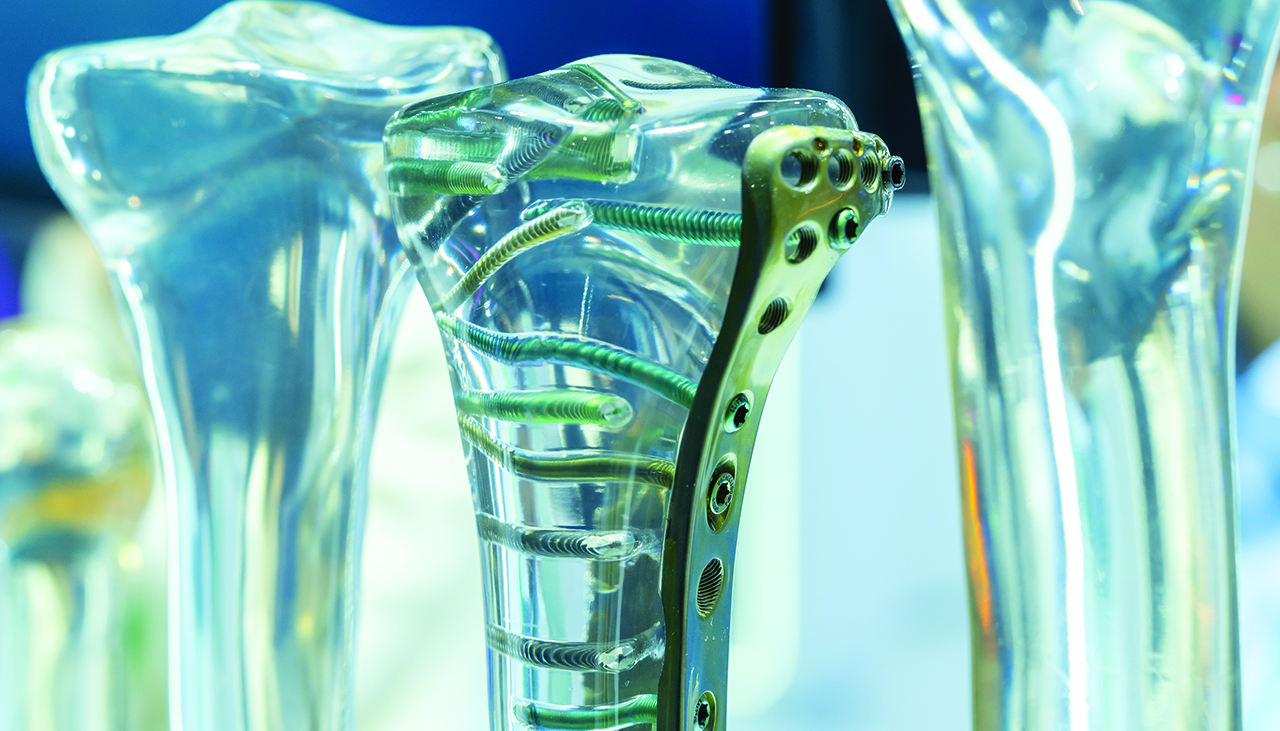
Standards for medical devices such as implants aim to give the aging increased mobility.
Dooley emphasizes the value of these standards to medical-device manufacturers. “ASTM standards are a great way to make devices comparable between competitors and over time. They are a cornerstone of the regulatory review process and have driven great improvement in spinal devices. Each generation of products benefits from the generations before it, all of which are touched by a continuously improving standard along the way, leading to better products. This has had an enormous impact on product safety, surgery success, and patient outcomes,” he says.
F1717 is one of 17 standards within the purview of F04.25, covering total disc prostheses, artificial discs, joint fusion devices, and other technologies in the modern arsenal of spinal-care professionals. Spenciner notes that, interestingly enough, the level of performance being achieved in these areas has enabled the subcommittee to turn its attention elsewhere.
“There aren’t a lot of brand-new, never-seen-before devices,” he says. “So a lot of the current focus of the spinal device subcommittee is on ensuring that our standards offer test methods that are repeatable across multiple laboratories. We’re doing a lot of interlaboratory studies on precision and bias.”
For those unfamiliar with ASTM protocols, all test method standards are required to include statements on precision and bias. Spenciner explains how the spinal device subcommittee is using these studies as an opportunity to further refine existing standards.
“For example, when we go through a standard like F1717 and perform one of these interlaboratory studies, one of the results is that we can check the box and write the precision and bias statements,” he says. “However, perhaps even more importantly, it allows us to go back and take a closer look at how different labs interpret the words we’ve written.”
This scrutiny revealed that there were indeed some areas that people could construe in different ways. “ASTM standards are truly worldwide, so there might be something that comes up that is obvious to us because we’ve always done it that way, but we didn’t make it obvious to someone who speaks English as a second language, or who is reading our standards through some sort of translator,” says Spenciner. “We’re able to look at the data coming from various laboratories and see how they interpreted the standard.”
From that point, subcommittee members can decide if they want to allow a certain amount of variation. “Or do we want to be much more prescriptive and narrow how the standard can be interpreted to drive each laboratory to perform the test exactly in the same way, or as close to the same way as possible,” Spenciner says.
A vice chair of F04.22 and a member since 2016, Leah Guenther can attest to the value of the iterative process of reexamination and refinement that is common to all ASTM committees – and to the role patients themselves play.
“The standards developed by F04.22 actually impact patients first,” she notes. “Their feedback goes on to shape the next generation of joint replacements through innovation and technology. The standards themselves don’t necessarily drive innovation, but they do provide a framework to test and evaluate new and existing designs, helping ensure that advances suggested by patients and surgeons are safe, reliable, and effective. Standards are like recipes: You don’t see the behind-the-scenes work, but they guide the process to get consistent and dependable performance results.”
Guenther also points out that F04.22 is part of a larger ecosystem within ASTM designed to oversee an implant’s journey from raw material to final clinical application. Other subcommittees are responsible for material test methods (F04.15) and polymeric materials (F04.11), for example, ensuring that implant materials and components are vetted before they are incorporated into a finished product. “Many F04.22 members also participate in these other subcommittees, which help provide visibility and opportunities for cross-collaboration.” Guenther adds that it is this cross-collaboration that ensures that, as the population ages, medical devices remain reliable, protecting both patient independence and the broader health care system.
F04.22 is responsible for no less than 41 active standards, a substantive body of work that requires constant refinement to keep pace with the evolution of orthopedic technology. Guenther cites at least six new work items currently in progress, including fatigue testing of humeral stems (WK81058) and evaluating impingement-free range of motion of shoulder replacements on reconstructed CT models (WK97199). These work items are driven by industry trends and need to meet the changing clinical needs of older adults.
Turning to the world of consumer products, the focus of the work of the subcommittees on safety standards for adult safety products (F15.70) and furniture safety (F15.42) shifts from internal products implanted to address orthopedic issues to external products that can pose a danger to those coping with the physical and mental limitations common among the elderly. Interestingly, some of these standards were inspired by, or even evolved from, standards developed for products geared to children.
Take adult portable bed rails, for instance. “You have to consider different things when you’ve got a product that’s designed only for adults,” says F15.70 chair Patty Edwards. “With a child, little legs can fit through small openings more easily than an adult. And children’s bed rails are often made of mesh and plastic, since they’re only meant for kids up to three or four years old, and you don’t have a heavy weight to consider.”
In developing the standard specification for adult portable bed rails and related products (F3186), the subcommittee had to take the full range of possible body types into account. “You can go from a frail, 80-pound woman to a six-foot-tall, 300-pound man. You don’t want him rolling on it and having it break,” Edwards says.
Product design was another concern. Adult bed rails are made of metal, and there are openings. “Body parts can fit through them. Maybe a person’s feet slide through and their necks get entrapped. That’s definitely a deadly hazard,” Edwards explains. “Another is if the bed rail, which is supposed to slide underneath the mattress and then be secured, is not installed properly. It can slide away and create a gap between the bed rail and the side of the mattress. If the patient rolls into that gap with his or her face up against the mattress, once again, that’s a deadly hazard.”
Like the original bed rail standard, the standard safety specification for clothing storage units (F2057) was born out of tragedy: in this case, children killed by dressers that tipped over and crushed them. Edwards recounts how influential the group called Parents Against Tip-Overs (PAT) was in driving efforts to make furniture safer, but notes that there were also instances of elderly people who were injured or even killed in similar accidents. “Manufacturers needed to ensure that a dresser’s center of gravity would be low enough that it would stay stable and not tip over even if a child or older person tried to climb it by opening the drawers,” she says.
The standard safety specification for liquid laundry packets (F3159) was developed in response to fears that the brightly colored, candy-like objects could be mistakenly ingested by kids. It prescribes packaging requirements designed to reduce unintentional exposures to the contents of the packets. And although the standard’s wording includes the phrase “especially to children,” its provisions are just as relevant to older adults who may be suffering from cognitive difficulties.
Edwards notes that nothing has changed in the standard since it was first approved in 2015 and then reapproved in 2022. “It’s not that it’s dormant, it’s just doing its job. To keep it active and widely complied with, every five to eight years the subcommittee will review and update it. They may tweak some of the language and it will be a revision, or they may just reapprove it,” she says.
Though some products – like liquid laundry packets – don’t change much over the years and thus do not require that their associated standards be revised, others do change, sometimes dramatically. Fortunately, ASTM committees are poised to take action when it becomes necessary.
“That’s the great thing about ASTM,” says Dooley. “Even if a new technology comes along and surprises us, we can react quickly to address that technology.” ●
Jack Maxwell is a freelance writer based in Westmont, N.J.
March / April 2026