
Loading...
Using Artificial Intelligence (AI) on ASTM standards and related intellectual property is prohibited. Violations will result in suspension of access.
By Mike Devine, Adams Magnetic Products
Mar 02, 2026
Magnetic fields are invisible, which is exactly why permanent magnets can be misunderstood, even by highly capable engineering teams. In our experience, the most common failure point in magnetics is not the magnet itself, but the assumptions surrounding it: what “strong” means; how performance should be measured; how environmental conditions affect the material; and how inspection results should be interpreted.
For manufacturers, these assumptions carry real business consequences. A magnet that doesn’t meet expectations can trigger product redesigns, warranty exposure, production delays, or rejected shipments. When engineers, buyers, and suppliers are spread across multiple sites—or around the globe—the risk of miscommunication increases. That’s where ASTM International standards become more than technical references. They become tools for alignment, consistency, and speed.
ASTM standards help Adams Magnetic Products and its customers speak the same language, verify performance with confidence, and reduce costly uncertainty in permanent magnet and magnetic assembly applications.
Permanent magnets appear deceptively simple. They come in a range of materials and grades, they can be coated or uncoated, and they can be formed into shapes from basic blocks to complex assemblies. Yet their performance depends on more than size and grade.
Magnets can operate in applications as varied as industrial automation, motion control, consumer products, oil-and-gas equipment, and medical devices with different loads, temperatures, humidity levels, vibration profiles, and lifecycle requirements. Even when the magnetic material is correct, performance can vary based on air gaps, mating materials, surface conditions, fixture alignment, and other factors that might not be obvious on a drawing.
This is precisely why standards matter. When requirements are vague, everyone spends time interpreting. When requirements are clear, teams move faster—and the risk of re-work decreases.
ASTM permanent magnet material standards provide a baseline for defining and verifying minimum performance characteristics. At Adams, these standards help us align expectations among engineering, quality, and procurement teams by offering repeatable criteria for the materials we source, test, and provide.
The committee on magnetic properties (A06) has established four key permanent magnet material standards that support this work:
In a business sense, what these standards provide is clarity. They support consistent magnet grade definitions and performance expectations across suppliers, internal teams, and third-party inspection groups. That consistency reduces the number of “spec debates” that can stall a project and improves confidence that suppliers are meeting the same baseline requirements.
For Adams, calling out ASTM materials standards within our internal documentation and customer communications helps us minimize ambiguity and focus attention where it belongs: on designing magnetic solutions that meet functional requirements in the real world.
In one anonymized case, a customer initially specified a magnet based solely on energy product (MGOe). When Adams reviewed the request in more detail, it became clear that the material specification provided did not align with the stated requirement. A sample was submitted for evaluation, and testing revealed that it did not match either the requested performance or the documented specification.
Rather than attempting a direct substitution, Adams modeled the magnetic circuit to determine the actual magnetic field required at the point of use. From there, an appropriate ASTM permanent magnet material specification was selected and documented as the governing requirement going forward. The result was a clear, repeatable standard that ensured consistent magnet performance—not just for the current build, but for years into the future. By anchoring the design to an ASTM specification, both parties gained confidence that the same magnet could be sourced reliably over the product’s lifecycle.
Even with clear specifications, testing and verification are essential, especially for applications where performance must be proven, not assumed. ASTM provides standardized test methods that support quality assurance and enable meaningful comparisons between measurement systems.
In our own processes, Adams relies on ASTM methods to verify key magnetic properties and support repeatable inspection, including:
These standards support a core business goal: reducing surprises. When performance is verified with a recognized method, it strengthens the supply chain by allowing customers and suppliers to compare results more reliably. It also improves the effectiveness of internal quality control, supports traceability, and reduces time spent reconciling conflicting measurements.
From a customer perspective, these standards help answer practical questions: “Does this magnet meet the intended performance?” “Are we measuring the same thing?” “Are the results repeatable?” The more consistently we can answer those questions, the faster projects move from prototype to production.
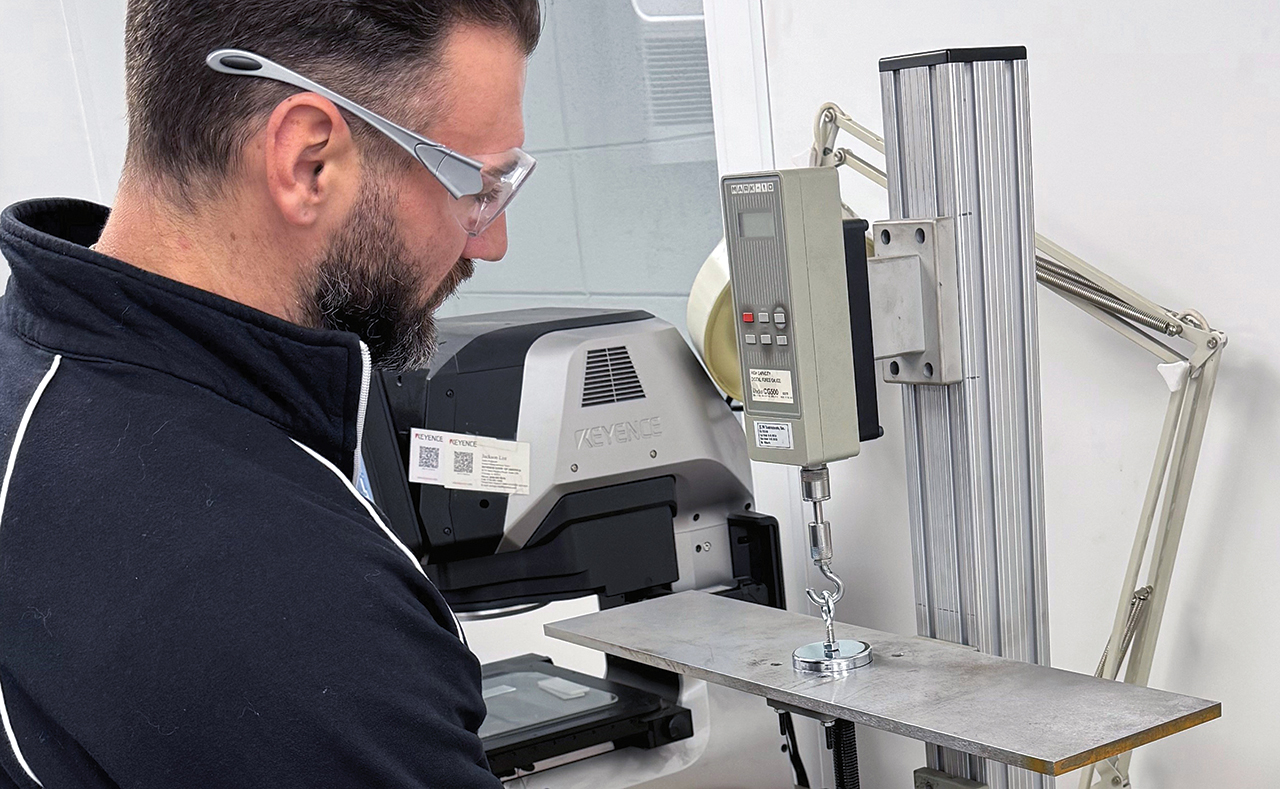
One area where standardization has a particularly direct business impact is pull-force testing for holding applications. Pull force is often used as a key acceptance metric for magnetic assemblies and holding devices. Yet it is also one of the most variable measurements in magnetics.
Pull force can change significantly depending on test setup and conditions, including surface finish, air gap, magnet alignment, fixture stiffness, test speed, and even the material and thickness of the steel used as the mating surface. It is not uncommon for two laboratories to test the same assembly and report different pull values, each believing their results are correct.
This variability has real consequences. When pull force results differ, it can lead to rejected shipments, delayed production, and prolonged debates over whether a part is “good” or “bad.” It can also force unnecessary redesigns and extra testing, adding cost without adding value.
The magnetic properties committee is currently working to develop guidance for magnet pull testing that clarifies best practices and reduces variability. From a business perspective, this work is essential. Better guidance improves repeatability, supports clearer acceptance criteria, and reduces disputes. For manufacturers like Adams, it creates a pathway to align testing practices across customer sites, suppliers, and third-party labs.
Standardization in this area is not about changing product design—it’s about improving decision-making. When testing becomes more consistent, supply chains become more resilient and projects move faster.
We view ASTM standards as a force multiplier. They help establish shared expectations that reduce the need for reinvention from project to project. They also support practical collaboration across engineering, quality, procurement, and supplier teams.
At Adams Magnetic Products, ASTM participation reinforces our mission: delivering magnetic products and assemblies that perform reliably in the field. Standards give us a stable foundation for material selection and verification, while enabling our engineering teams to focus on the real value-add: designing solutions that integrate seamlessly into customer systems.
When ASTM standards are used thoughtfully, they support business outcomes that matter: reduced risk, fewer disputes, better repeatability, and faster development cycles. In a world where speed and reliability are competitive advantages, standards help make both possible.●
Mike Devine is director of technology, Adams Magnetic Products, LLC.
Headquarters: Elmhurst, IL, USA.
Company Website: adamsmagnetic.com
Description: Adams Magnetic Products designs and manufactures permanent magnets and magnetic assemblies, helping OEMs improve performance and reliability through material expertise, testing, and standards-based verification.
Trading Area: Global with a focus on North America.
March / April 2026