
Loading...
Using Artificial Intelligence (AI) on ASTM standards and related intellectual property is prohibited. Violations will result in suspension of access.

By Donovan Swift
Dec 28, 2025
Per- and polyfluoroalkyl substances (PFAS) have been making headlines lately, as they have been found in our waterways and elsewhere, but little is known about the long-term health effects of PFAS exposure. That’s why ASTM is developing ways to test levels in our waters and elsewhere to help mitigate PFAS exposure. I spoke with William Lipps, past chair and current vice chair of the committee on water (D19), about how current, recent, and developing standards are helping address this issue.
PFAS was first monitored nationwide in the U.S. EPA’s Unregulated Contaminants Monitoring Rule 3 (UCMR). During this monitoring, EPA set the required minimum reporting limit in the range of 10–90 ng/L.
Only six PFAS were monitored. Keep in mind that the UCMR is designed to screen for potential contaminants, so there was already some data that PFAS was in drinking water supplies, but national occurrence data was not available.1
Once the PFAS data came in from UCMR 3, a major finding by Andy Eaton with Eurofins Eaton Analytical brought more attention to the issue. He looked at their data below the reporting limit requested by EPA for UCMR 3 and found PFAS to be more widespread than the UCMR 3 data suggested.2
Then organizations such as the Environmental Work Group caught on and started releasing studies showing widespread PFAS contamination at lower concentrations.3
Because of the “reach” of groups like this, mainstream media caught on and began reporting that millions of Americans are exposed to PFAS.
The standard test method for determination of per- and polyfluoroalkyl substances (PFAS) in aqueous matrices by co-solvation followed by liquid chromatography tandem mass spectrometry (LC/MS/MS) (D8421) was originally developed in about 2015, as the standard test method for determination of per- and polyfluoroalkyl substances in water, sludge, influent, effluent, and wastewater by liquid chromatography tandem mass spectrometry (LC/MS/MS) (D7979). Later, the committee on water expanded the analyte list of D7979 to 44 PFAS compounds and rather than updating D7979, we developed and validated a completely new method. Operationally, however, the methods are the same.
When we developed the methods, our goal was an easy extraction for contaminated samples, like wastewater, that are problematic during more conventional extractions, such as the solid phase extraction (SPE) used in the EPA methods. Instead, we collect a 5 ml sample, and in the lab, add labeled isotope to use as surrogates or internal standards, and then add 5 ml of methanol. Experiments made during the optimization of D7979 demonstrated that the 1:1 methanol to sample ratio worked best to keep all the PFAS in solution. Once the sample is mixed with methanol, it is mixed and filtered (some labs centrifuge). This pre-mix (called cosolvation) with methanol enables us to filter the sample and not lose any PFAS. Additionally, since the method adds the methanol to the 5 ml sample in the collection vial, no PFAS is lost by transfer. By performing cosolvation rather than SPE, the method gets near 100% recovery on all compounds in very complex matrices without requiring a recovery correction.
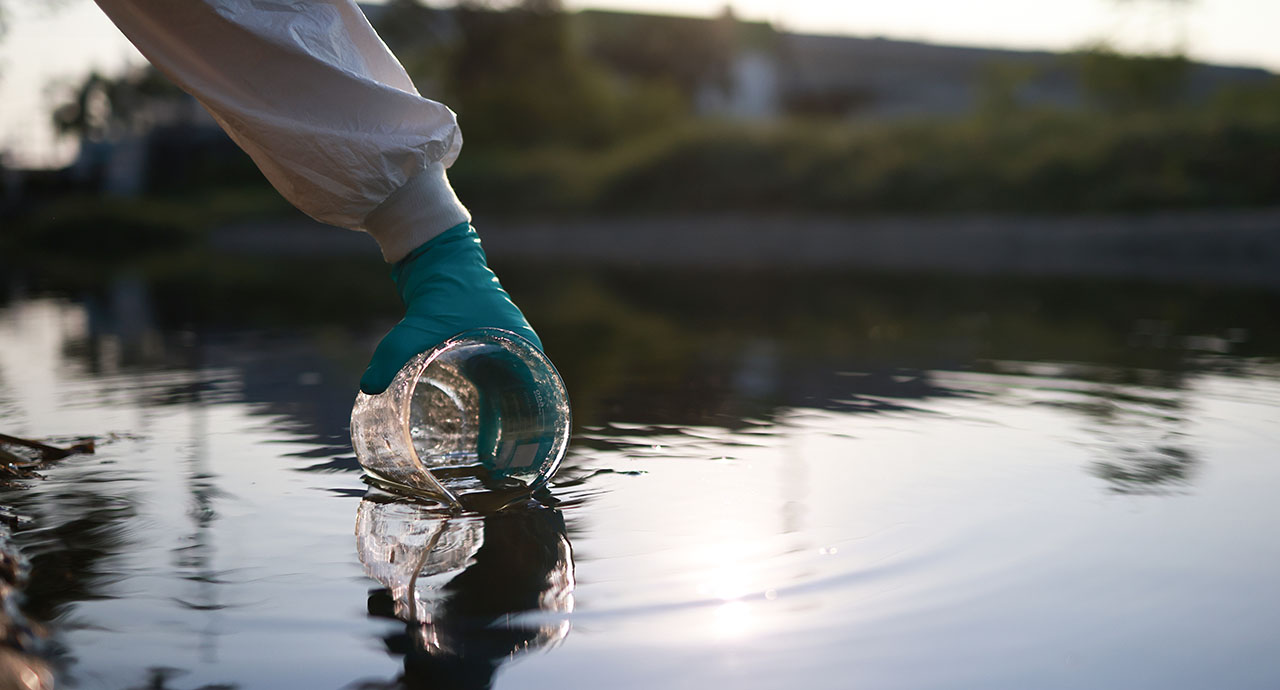
The method is designed for samples that may contain high levels of PFAS. Currently, we have validated it with a lower reporting limit of 10 ng/L. We believe that this lower limit is sufficient for wastewater samples, particularly pretreatment and liquid biosolids, or very contaminated samples. With sensitive instruments and clean matrices, however, the method is capable of accurately measuring PFAS below 2 ng/L.
In D19, we strive to develop new methods that decrease solvent and consumable usage and thus decrease the generation of waste. Additionally, by decreasing the sample volume, we lower shipping costs. For example, we sample 5 ml and the corresponding EPA method samples 500 ml. Thus, as shown by the interlaboratory study (ILS), we have a highly accurate and precise method for the analysis of PFAS in clean to highly contaminated samples that requires only minimal sample preparation and no expensive sample preparation equipment or consumables. The method generates minimal waste and minimizes shipping costs.
The work item (WK88987) is a proposed method for shorter chain PFAS that are not included in D8421 or any of the EPA methods. We know that labs are analyzing for these compounds, such as trifluoroacetic acid (TFA). However, there are no standardized methods. Unlike D8421, this method does use a small volume SPE extraction to separate the PFAS from potential interferences. We intend to do an interlab study on this method and expect global adoption.
We are in the planning stages of an extra ILS for D8421 on liquid biosolids. We know the method works and have data from two labs on the same samples. Additionally, in the waste management committee (D34) we have a PFAS method (D8535) for soil and solid samples that is very similar to D8421.
The method accurately detects PFAS at lower concentrations than the EPA method, with a much quicker and less labor-intensive extraction.
In the consumer products committee (F15), we are developing a PFAS method for consumer products that is based on D8535. Other approaches that are needed and need to be standardized are high-resolution analysis to help find and detect PFAS as a group rather than individual components; standardization of assays such as oxidizable precursors or extractable organic fluorine; and measuring PFAS not readily amenable to liquid chromatography–mass spectrometry (LC-MS/MS), but that can be analyzed by gas chromatography–mass spectrometry (GC-MS) methods.
I joined ASTM in 1986 when I worked at a lab started by my father in 1954. He worked on several ASTM methods, including the standard test method for determination of calcium fluoride in fluorspar by complexometric titrimetry (E815). Most of my involvement at ASTM at this time was in the committee on analytical chemistry for metals, ores, and related materials (E01) and involved voting on methods or participating in a few interlab studies. (It was all by snail mail back then.) Participation was harder for me then because travel to meetings was more necessary. I was able to get onto the committee on water after we sold my father’s lab and I was working for a commercial laboratory in Wyoming. Again, my involvement in ASTM was mostly voting and maybe one ILS.
In 2004, I began working for OI Analytical. The company manufactured segmented and flow injection analyzers and had technology for analyzing cyanide that was unique and very effective. One of the methods had obtained EPA approval through the ATP process before I started with OI, but no one left understood it, and there was no real advancement of the product. Additionally, the technique could be used for other forms of cyanide but there were no published methods. Because instrument companies allow you to travel, I was able to attend ASTM meetings and started becoming very involved at ASTM. With a small group of people over about seven years, we developed and perfected the cyanide methods, a sampling and preservation practice, and several guides. We also took the same methods and – through the TC147 technical advisory group on water quality – got them published at ISO. At one of the meetings, Alyson Fick, the D19 staff manager at the time, suggested I run for an officer position in D19. This election got me involved at the committee level, which I have enjoyed immensely.
Involvement in ASTM and writing the actual methods enables you to meet and get to know other experts in the industry. I have been able to collaborate with people that I otherwise would not have met. I can work with competitors in a non-competitive manner because the end goal is standardized methods that work for all of us. Through ASTM, I have joined ISO and been able to meet and collaborate with people in other countries, too.
References
1) S. Faber. “For 20-plus years, EPA has failed to regulate ‘forever chemicals’.” https://www.ewg.org/research/20-plus-years-epa-has-failed-regulate-forever-chemicals. Jan. 9, 2020.
2) A. Eaton. “A Further Examination Of a Subset Of UCMR 3 PFAS Data Demonstrates Wider Occurrence.” https://pfascentral.org/perch/resources/science/andyeatonucmr3pfasdata-1.pdf.
3) S. Evans, et. al. “PFAS Contamination of Drinking Water Far More Prevalent Than Previously Reported.” https://www.ewg.org/research/national-pfas-testing. Jan. 23, 2020. ●
Donovan Swift is managing editor of Standardization News.
William Lipps is general manager of government and regulatory business development at Shimadzu Scientific Instrument, where he develops and publishes new alternative test procedures, as well as working on international standards with organizations such as ISO, ASTM, and AOAC. Lipps is the past chair and current vice chair of the committee on water (D19), and the membership secretary of the committee on waste management (D34). He is on the joint editorial board (JEB) of Standard Methods for the Examination of Water and Wastewater, a member of the AOAC official methods board, and an ANSI delegate to ISO TC147. Lipps has developed or supervised the development of multiple new or revised methods in water, soil, food, and industrial minerals with nine methods either promulgated or pending promulgation.

January / February 2026