

Loading...
Using Artificial Intelligence (AI) on ASTM standards and related intellectual property is prohibited. Violations will result in suspension of access.
By Donovan Swift
May 01, 2026
We take the performance of many products for granted. When we drive to work, we expect to arrive safely, without giving much thought to our tires. Yet that’s thanks to materials many of us don’t realize are there: carbon black and recovered carbon black (rCB). Among other uses, these materials help reinforce tires and keep them from falling apart as we drive mile after mile. I spoke with Joseph Hallett, secretary of the subcommittee on rCB (D36.10), and Pieter ter Haar, chair of the committee on rCB (D36), about the difference between the two materials, the sustainable benefits of rCB, and more.
Joseph Hallett: rCB is the solid, carbon-rich material that is formed when rubber articles are heated in the absence of oxygen (pyrolysis). This process forms an agglomeration of the carbon blacks and inorganic materials in the rubber formulation, bound together by a carbon layer formed in the reactor. Its primary function is as a sustainable alternative to carbon blacks, with most of it being reused in the tire industry as a reinforcing filler. It can also be used as a pigment in plastics and coatings. Like carbon black, rCB helps maintain the performance of the products it is contained in, for example, helping tires maintain air pressure.
Its primary difference from carbon black is its composition and the size of the primary “particles.” Carbon black is typically over 99% carbon and is sub-micron in size. rCB, on the other hand, can contain over 20% non-carbon materials and is usually on a micron scale (10 to 20 µm being a typical size range). Carbon black and rCB also have different measurement methods that define their performance.
Pieter ter Haar: rCB is a recycled product from end-of-life tires. Within a tire, you find many different types of carbon black, and up to about 25% of a tire’s weight consists of that carbon black. Without it, the tire would not last more than 100 km, as it gives strength to the rubber.
There are companies that have developed technologies to recycle this valuable material, and after various processing steps, make it suitable for use in new tires again. So that’s rCB. There are some similarities, therefore, with carbon black. It looks very similar. It behaves similarly in certain applications. Some process steps are similar, but there are also big differences.
Carbon black is considered a mono-constituent, and basically what that means is all these particles look the same, and so what one particle does represents what all these particles do. rCB, however, is more of a composite material, and consists of a blend of all the different kinds of carbon black that are in the tire, as well as a few other materials that come out of the recycling process that are still embedded in the rCB. So rCB is basically made up of three different components, whereas a carbon black is just this single component. I think that’s the biggest difference.
rCB is a recycled product and extracting it from waste tires creates far less CO2 emission than creating new carbon black. The chemical recycling process used to recycle the waste tires also converts the rubber part of the tire into tire pyrolysis oil (TPO). TPO can be used again as a feedstock for conventional carbon black, new plastics or rubbers, or for the production of sustainable aviation fuel (SAF). So it’s a more sustainable product that fits nicely into the circular economy.
JH: This standard was developed at the request of the industry to enable the products from different producers to be easily compared. It follows the initiative from Michelin and Bridgestone to create a purchase specification for rCB. While not as comprehensive as this purchase specification, it does allow different rCB types to be separated. At the moment, it’s a work in progress, and we are planning to add more parameters when tests become available, the key one being a test method for agglomerate size.
PH: When rCB products were first introduced, everyone wanted to characterize them as carbon black because rCB looks like carbon black and is being used as carbon black. But we quickly realized that most of the standards and test methods that were used to determine carbon black’s properties were not suitable for recovered carbon black.
So when we started the committee, we knew we eventually wanted to develop a characterization and classification standard, which became the standard classification for recovered carbon black — rCB used in rubber products (D8632).
Basically, we know that there are multiple “flavors” and types of these rCB products just like with carbon black. When we knew which parameters separate one rCB product from another, we were able to create the classification system so producers and users can better distinguish the different types of rCB.
The classification system consists of the two most prominent performance indicators that can be differentiated. Relevant bandwidth ranges were established, enabling us to name these products and group them together.
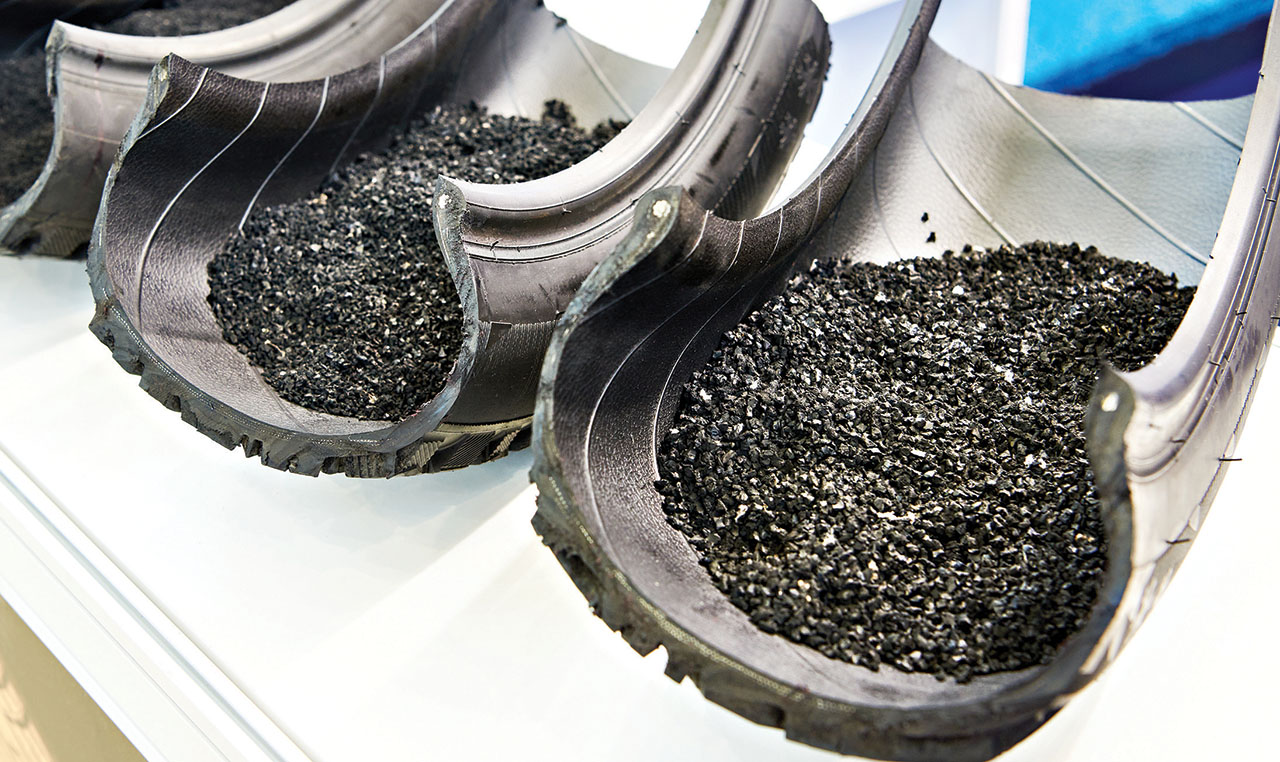
Recovered carbon black fits nicely into the circular economy.
PH: Some of the parameters correlate to how well the rCB may reinforce the rubber. And so that tells the end user a lot about which rCB is most suitable for their application. A car tire is a highly advanced, engineered product. We cannot risk the tire falling apart or there being some quality issues or unknowns with these materials. So it’s very important that we standardize the test methods for these materials, holding the new recycled products to the same standard that we expect of any other raw material that goes into these products.
Many car producers and tire manufacturers have also set sustainability goals, and they want to be 100% sustainable by 2050. That means they want to work with sustainable materials but preferably with circular materials, like rCB.
JH: The rCB committee (D36) is working on a range of standards that will help the industry quantify key attributes. One of these is the new test method for dry powder rCB particle size analysis via laser diffraction (WK87480). This is a test method to measure the agglomerate size of a sample of rCB. This property is a key performance differentiator between products and a key QA tool. The new test method for non-carbon constituents of rCB (WK91253) is a method to characterize the non-carbon inorganic content of a sample of rCB. This is important from a regulatory point of view, as it is important to know the composition of the inorganic content of the product, as certain substances have regulatory limits.
One key initiative that will soon be published is D8654 (WK84622), the new practice for preparing life cycle assessments for recovered carbon black products (interim product category rules). This practice standardizes the methodology to be followed when calculating the environmental impact of rCB (e.g., its carbon footprint). By standardizing the methodology, customers will be able to compare environmental claims from different producers. This practice was produced with the assistance of the whole value chain, with experts from both producers and end users of rCB.
PH: We are constantly developing more technical standards. One of the important standards in development covers a test method for the measurement of the particle size distribution of rCB products. The production process of rCB involves grinding the material into a very fine powder with very small particles, typically below 10 microns, which is smaller than a hair. Currently, there is no validated test method for this parameter. Particle size is another important performance parameter of rCB, so it’s essential for both producers and end users, such as tire manufacturers, to be able to have a standard in place to measure particle size distribution of rCB.
JH: I am a professional engineer by training, and I have worked in a number of roles in the rubber industry, including product design, R&D, and customer support with several companies. I have worked in the carbon black industry since 2002 and with rCB since 2013. In my current role I am technical lead for our Continua SCM (rCB) product range. My company has been actively involved in the carbon black committee (D24) since its inception, so I have been aware of ASTM’s activities since I joined Columbian Chemicals Company (now Birla Carbon) in 2002. I first joined ASTM in 2015 when D24 started discussing rCB in its sustainability subcommittee, and I was R&D director for a small rCB producer in Germany. I then also joined D36 when it was formed. After rejoining Birla Carbon, I became its official representative on D36.
PH: I first came in contact with rCB as a rubber compounder for Fenner Dunlop (now Michelin) . I then became Joseph’s colleague for a year in one of the first start-up companies in this field. After working there for five years in Germany and North America, I joined Circtec as rCB Director seven years ago.
I went to my first ASTM meeting in Vienna 10 years ago. This was a D24 meeting, and there was a one-minute discussion on sustainability in a subcommittee. Understanding some of the key differences between rCB and conventional carbon black at the time, there seemed to be a need for a more dedicated committee to work on standards and test methods for this new sustainable material, rCB. After the meeting, I spoke to staff manager Joe Koury and Tony Thornton, who was the chair of D24 at the time, and asked them, “Why are we not doing more? Because I have a lot of data to show that rCB is very different.” And this is when we discussed the idea for a new committee on rCB. Joe took it upon himself to move that suggestion along and half a year later, we had our own committee. ●
Donovan Swift is managing editor of Standardization News.
Dr. Joseph Hallett has worked in the rubber industry for over 30 years in a number of roles, including product design, research and development, and customer technical support. He has worked for a total of 18 years at Birla Carbon and is part of the team developing a range of sustainable carbonaceous materials (rCB). He is secretary of the subcommittees on rCB (D36.10) and environment, health, and safety (D24.66).
Pieter ter Haar is chair of the committee on recovered carbon black (rCB) (D36) and was a founding member of the committee. He has worked in the rubber and rCB industry for many years, including roles with Fenner Dunlop (Michelin) and Circtec, which he joined seven years ago as director.
May / June 2026

