
Loading...
Using Artificial Intelligence (AI) on ASTM standards and related intellectual property is prohibited. Violations will result in suspension of access.
By Donovan Swift
Feb 27, 2026
In 2021, the large container ship Ever Given ran aground in the Suez Canal, blocking other cargo ships from passing. It was the worst-case scenario in many industry experts’ minds: One of the busiest trade routes in the world was blocked with no immediate way to remove the obstruction. Not to mention that over 80% of globally traded goods are carried on ships, according to the U.N. Trade and Development (UNCTAD) – and this happened during a surge of pandemic-era trade. The canal was blocked for just six days, yet it’s estimated to have delayed $400M worth of goods per hour, or $9B per day.
The ripple effects of this incident (higher shipping costs for consumers, supply chain vulnerability, shipping delays), along with the sheer volume of goods carried on shipping vessels, speaks to the importance of ships running smoothly and safely. The performance of these vessels, even those operating thousands of miles away, affects us all.
While incidents with big container ships make headlines, safe passage of smaller vessels, like towboats, ferries, and cargo vessels, is also key. Over 19 million Americans traveled on cruise ships alone in 2024.
Yet in an age of artificial intelligence and supercomputing, older forms of maritime technology are often taken for granted. However, many of these older technologies have been upgraded for the needs of a globalized world, and that means there are new challenges to keeping these ships afloat. And with ships nearly as heavy as the Empire State Building, standards that help ensure their safe passage are essential.
ASTM International’s committee on ships and marine technology (F25) have standards to help ensure the safe and efficient operation of these ships. Standards cover everything from the hull and structure of the ship, mechanical and electrical systems, cybersecurity, piping materials, lithium-ion battery usage, and the process of recording and reporting near misses at sea.
“The committee develops standards with the objective to aid quality improvement, risk reduction, marine environmental protection, and reduce cost in the shipbuilding, ship operation, and marine industry,” says Daniel Wesp, chair of the committee. “The scope of standards is broad and there is no one vessel type that is the sole focus. Most standards can be applied to multiple types of marine assets for both international and domestic geographical service applications.”
The sheer size of many container ships and large vessels seems to defy physics. Many of these larger ships weigh upwards of 200,000 tons, but even smaller vessels, like towboats, weigh 200 tons or more, so proper design is essential to ensure their safe passage. That is why the committee has standards that address the quality requirements for hull structure (F2016), weight control for surface ships (F1808), and small craft stability testing (F3052).
However, machinery and piping systems are just as essential to a ship’s functionality. Ship piping systems often carry fluids that are flammable, combustible, high-pressure, or otherwise dangerous, so the selection of materials used to construct these pipes is critically important for keeping ships safe. The standard practice for selection and application of piping system materials (F1155) is especially important, according to Wesp. “This practice is relevant to all ship types,” he says. “It is intended as a guide to shipbuilders, shipowners, and design agents for use in the preparation of piping system material schedules for commercial ship design and construction.”
Vital piping systems, which include a ship’s fuel system, fire main, and fixed fire suppression systems, must use specific materials to ensure the safe passage of those fluids. According to the Code of Federal Regulations (CFR) 56.60-20, “The low melting points of many nonferrous metals and alloys, such as aluminum and aluminum alloys, must be recognized. These types of heat sensitive materials must not be used to conduct flammable, combustible, or dangerous fluids.”
READ MORE: Taking a Bite Out of Cybercrime
While these regulations are essential for onboard safety, the CFR table of acceptable materials and specifications (CFR 56.60-1) hadn’t been significantly revised since 1969, and the list of materials was narrower than those recommended elsewhere.
“For example, F1155 permitted the use of B61 and B62 bronze valves in most systems that did not contain flammable, combustible or dangerous fluids,” Wesp says. But as materials and best practices have evolved, the regulation now includes F1155 as a reference point for several different acceptable types of piping materials, including carbon steel and ferritic alloy steel.
In November 2025, The U.S. Coast Guard’s (USCG) Alternate Compliance Program also referenced F1155 regarding materials used for fire main and hydrant piping components on vessels registered in the U.S. “By utilizing the standard practices outlined in F1155 and respective USCG policies, materials selected will be considered as providing a level of safety equivalent to that intended by the CFR,” Wesp says.
In a world of renewable energy, hybrid and electrical power sources are key to the sustainability of many vessels. Lead-acid and nickel-cadmium batteries have been used aboard ships for years to power various electrical needs, but lithium-ion batteries are becoming more widespread. Because lithium-ion batteries are so energy dense, they can be used to power the ship’s service electrical power, emergency power, and even the propulsion of the ship.
The benefits of lithium-ion batteries are clear, says committee member Thane Gilman. “The primary benefit of lithium-ion batteries is the relatively high capacity, in kilowatt-hours, compared to traditional battery designs such as lead-acid or nickel-cadmium,” he says. “This is important in transportation applications such as vehicles or ships, as lithium batteries provide an excellent power-to-weight ratio. The other significant benefit is environmental, as batteries are a zero-emission power source.”
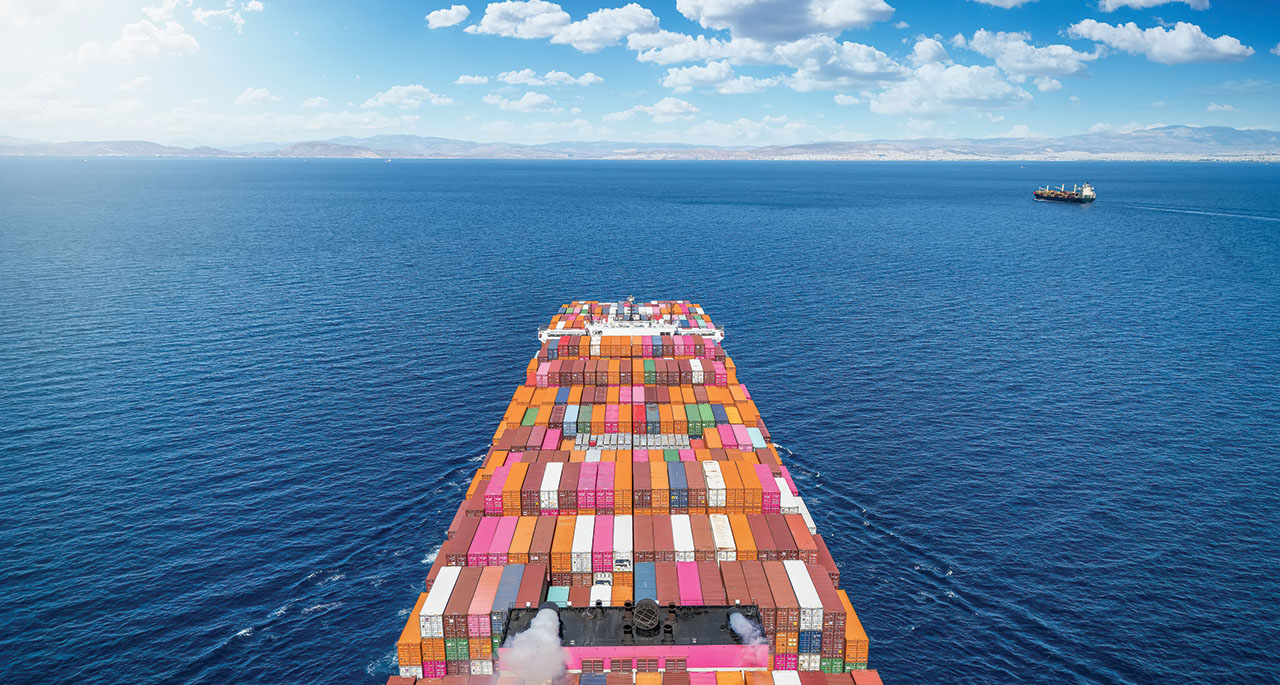
The sheer size of many container ships and large vessels seems to defy physics.
Currently, lithium-ion batteries are used on smaller vessels, but that might not always be the case. “The types of vessels that are currently employing lithium-ion batteries for propulsion or electrical power are currently smaller designs such as towing vessels, recreational boats, and small passenger vessels or ferries,” says Gilman. “Although in theory, batteries can be scaled up to any power level. But large oceangoing ships can require power levels upwards of 100 megawatts, and currently we have not seen maritime battery installations even close to that power level.”
There are, however, unique safety concerns with lithium-ion batteries, which is why the electrical subcommittee (F25.10) developed the standard guide for shipboard use of lithium-ion (li-ion) batteries (F3353) to aid their safe use and installation.
“The safety concerns with lithium-ion batteries primarily arise from inadequate design and testing, which can result in ‘thermal runaway’ or fire events during charge or discharge,” says Gilman. “These types of fires are extremely difficult to extinguish, and on a ship, this is a significant risk. The standard specifies battery testing in accordance with recognized Underwriters Laboratories (UL) and International Electrotechnical Commission (IEC) standards, and this type of rigorous testing can help mitigate the risks.”
The use of lithium-ion batteries has gained traction in the last several years, and the USCG released a policy letter in 2019 discussing safety precautions. The letter references F3353 as an “acceptable method” for the installation of lithium-ion battery systems onboard commercial vessels.
In 2019, the Viking Sky lost power off the coast of Norway. The cruise ship, carrying 1,374 passengers, was suddenly stranded in a rough stretch of the Norwegian Sea, with strong winds and 49-foot waves. Without power, the ship was unable to be steered and came less than a ship length away from running aground.
While some passengers were evacuated by helicopter, the crew eventually got the engines restarted and the power restored. The ship reached port with the support of a tugboat, and while 20 people were injured, the accident could have been much worse.
According to a report from the Norwegian Safety Investigation Authority (NISA), the accident was caused by “insufficient lubricating oil in all of the operating diesel generators’ lubricating oil sump tanks,” which caused the engines and power to automatically shut down. The blackout was lengthened, the report also found, because proper blackout procedure “had never been drilled on board.”
Accidents are inevitable, in the world and the maritime industry, but it is possible to learn from accidents and try to avoid repeating them. It is also just as useful to record the circumstances surrounding near misses, which are “events with no [or few] consequences, but that could have reasonably resulted in serious consequences under different conditions,” according to the American Bureau of Shipping. Many accidents or near misses aboard ships follow from a series of events or conditions, and reporting these conditions makes it possible for others to avoid creating a similar environment.
The information collected by near-miss reports can be anything from the time of day, personnel involved, weather conditions, to equipment used. The standard guide for reporting and recording of near misses for maritime industry (F3256), developed by the general requirements subcommittee (F25.07), provides a framework for how best to record the circumstances of a near-miss incident, analyze the information, and make improvements to a ship’s safety program.
FOR YOU: Trade Compliance in Global Supply Chains
“There is not one particular or specific accident or type of near miss that initiated the development of F3256,” says Todd Ripley, past committee chair and current member. “So, to better track such a range of incidents and learn from them, standardization of reports is needed to improve data collected.”
One of the common barriers to collecting near-miss data is fear of blame by the individual reporting the near miss. But the collection of quality data helps keep people safer, which is why a voluntary program for confidential reporting, SafeMTS, was launched in 2024 by the U.S. Department of Transportation (DOT), with endorsements from the National Transportation Safety Board, plus other maritime safety interests.
The program’s goal, according to the DOT, is to “identify safety-related trends to prevent more serious incidents, share results with the industry, and inform near-miss standards to improve the reporting of meaningful near-miss information.”
As more near-miss data is reported through the SafeMTS program, subject matter experts will be able to see which kind of information is most useful in avoiding accidents. This information can then be used to update F3526, so that the standard stays up to date with the latest data and offers the best framework for reporting near misses.
The USCG, an active participant in the development of F3256, said it is “fully supportive of this DOT initiative as a significant effort to improve safety on the MTS and reduce both near-miss events and reportable casualties.”
In the aftermath of the Viking Sky incident, the NISA has implemented several new safety recommendations, demonstrating how analysis of near misses can help industry professionals avoid recreating the circumstances that may someday lead to a true catastrophe.
While humans have been conquering the seas for thousands of years, the ships of today are complicated technical vessels that carry massive loads and have equally large safety considerations. That’s why the committee on ships and marine technology has standards to address the many different facets of today’s ship, from structure to cybersecurity to accident reporting. So, whether they’re carrying 80% of the world’s cargo or honeymooners vacationing on a cruise, standards help ensure that ships sail safely and efficiently.
With evolving technology in the maritime sector – including micro-reactor technology, artificial intelligence, and autonomous applications – the committee on ships and marine technology welcomes participation in the development of future standards. To get involved, contact staff manager David Lee at dlee@astm.org.
March / April 2026
